KAWARTHA LAKES-Before moving to Bobcaygeon, George and Susie Lee had lived on a farm near Stouffville. “He used to drive down to Florida to pick up goldfish and bring them back to Ontario—I don’t know what the business arrangements were for this,” his granddaughter Betty Anne Shaw explains. “When they first came to Bobcaygeon, they lived in a house on Main Street.” Later on, they lived on the south side of King Street, between their creamery and the fairgrounds.
George and Susie had four children “and none of them went by their legal names. My mother was the oldest and she was the closest in name. Her name was Kathleen, and they called her Kay (Martin). Her sister was Erma, who they called Cleo (Hill). Isabel Jean was called Betty (Shea), while Lloyd was called Jesse.” He had played the American post-Civil War outlaw Jesse James in a public school play and the name stuck. In the early 1950s, George bought a farm on Echo Bay Road, and “he was interested in Hereford cattle—he would show them. Uncle Jesse took over more of the work at the creamery when grandpa started farming. Jesse and Cleo had gone to Kemptville to take a course on butter making.”
Betty Anne remembers George as being quieter, but “Jesse was a jokester. When I was a kid, he had false teeth on the top, and he would drop them down to make you laugh at them. He would try to scare or spook us a little bit.” The family enjoyed sports like curling and softball. “Jesse scored the first goal at the new Bobcaygeon arena when he was playing on Bobcaygeon’s Intermediate hockey team. His skates squeaked, which made the spectators laugh. Ross Poole was the goalie for that team.”
Bobcaygeon’s creamery was a cement block building, with double doors on the street side and a window on each side. “It was all cement walls inside. When you walked in the front door, there was a counter on the right. The window on the right-hand side was the office. The window on the left-hand side was where the incoming cream was tested for its butterfat content.” The amount that farmers were paid for their cream reflected its butterfat content. On the south side of the building, “there was a place where the trucks were unloaded and a scale for weighing the cream cans. That’s where they were unloaded, and the lids taken off. There wasn’t any refrigeration back then. I remember sometimes when they took the lids off, the smell was pretty gross. My uncle would test it all. Whoever was working in the office—either my mom or my aunt would write down everything that he said to them. The cream cans were marked with a number or the person’s name and their weight. I think he tasted the cream.”
“The cream was put into little jugs in a case, then he dumped them into the centrifuge, and he could tell you what the butterfat content was from each cream pail. Each person who sold cream had an envelope, which would list the person’s name, what their cream pail weighed, the butterfat content and the price paid per. Then my mom or my aunt would tally what would go to each farmer. When the drivers went out on their routes, they gave the farmers the money for the last cream they provided. It was all cash, there were no cheques issued. If the farmer wanted to buy butter, it would be delivered at the same time, and the cost deducted from their pay.” The creamery also had its own gas pump with a glass cylinder on top, which was on the left side, beside the driveway where the trucks came in. A boiler heated the building and the water that was needed for cleaning the apparatus.
The Bobcaygeon creamery hired several different drivers over the years. In earlier years Jack McCullum and Henry Kittle were drivers. “Their responsibility wasn’t just to drive the routes, when the cream cans were emptied, they would have to clean them.” Later on, Don Campbell and George McIllmoyle took the truck out on the circuit. “Some people had stands at the end of the driveway that they would put the cream cans on for the creamery.” Earl McGuire worked with Jesse processing the cream. “We didn’t churn butter every day. Some days when you went in it was very quiet.”
“Jesse put the cream into the churn, and I remember him putting in a pailful of salt, because they were making salted butter. I don’t remember unsalted butter being a choice back then. He used a long handled wooden paddle, to put it into another machine that formed it into a rectangle. It came out of that machine on a conveyor belt. As a stick of butter came out, he would pull down a lever that would cut it into four different pounds of butter at a time. To prepare to wrap the butter coming out, we would soak the wrappers to make them more pliable, and flip them so the corner was turned and they could be grabbed more quickly. The whole family would be there working together as we wrapped the butter by hand. My aunt, my mother, Jesse, my cousins and myself, we would all wrap butter. Whatever help was on hand. Since I was growing up on the farm, I didn’t work there as often as the others, and I was not as fast at wrapping butter as they were. The Creamery did have its own distinctive wrapper. Once the butter was wrapped, it was packed into wooden boxes, with a lid. There was a cooler at the back of the creamery, so the butter could be kept cool until it was delivered to the different stores. Then the cases would be passed out through a hole in the wall.”
“There was not a lot of butter sold at the creamery. Some went back out on the routes, but most of it was sold to local stores. Margarine was not as much of a thing back then. It was always butter on our table.” By the mid twentieth century, having bread and butter becoming an everyday thing, something that people wouldn’t think twice about—whereas a couple generations earlier, hours of work would have gone into producing that bread and butter.
Most of the buttermilk was used as feed for pigs. When Betty Anne was a girl, her grandfather kept the pigs at her parent’s farm, “where he brought the buttermilk out to give to them as feed. “He had different pens with pigs at different stages in their development.” Harry Van Oudenaren recalled that a few people even kept pigs in town. “People would come in with their own container and get some buttermilk. Uncle Jesse would have a couple containers in the cooler for people that wanted buttermilk.”
The Bobcaygeon creamery sold DeLaval cream separators, as did Bottum’s Hardware store, located closer to the locks on the same side of Bolton Street. “There were a couple of separators there. They were just hand operated—though some people might have hooked them up to electricity.”
In the mid twentieth century, Dr. Henderson had begun to produce ice cream on North Street in the old cheese factory on a small scale. In 1955, Jack Crowe decided to expand his business to produce ice cream alongside milk, as he took a course at the Ontario Agricultural College at Guelph on its production. From then on, Kawartha Dairy used far more cream. More families were acquiring household refrigerators and freezers, so they could keep milk and ice cream, beyond what would immediately be consumed. Standards were also changing for dairy production as farmers were required to meet far more stringent requirements. In the 1960s, a system of dairy quota was introduced to stabilize prices. The era when just about every farm kept few a milk cows was coming to an end, as a few farms began to specialize in dairy production.
“Stirling Creamery bought out Uncle Jesse, now it is part of Gay Lea. After he worked at the dairy he went into farming and would take over his father’s farm. I think the creamery may have sat empty for a while, before Don Whyte took it over.” Don would convert it into an autobody shop, before selling it to Arthur Logan.” In 1979, the building was demolished to make way for the new Bobcaygeon Post Office. By then times had changed. The days when most families kept a few milk cows were over, and not many families would feel comfortable drinking raw milk from their own cows. Just about every family had a refrigerator, and people were used to buying milk and butter at the store. Families would buy a brick of ice cream—some Bobcaygeon parents could remember what a special treat ice cream had been when they made it by hand, churning sweetened cream in a snowbank until it solidified. Many younger people would be surprised to hear that their grandparents could remember when there were multiple cheese factories in the Bobcaygeon area and that the village was once home to three dairies and a creamery, all processing the produce that local farm families had milked by hand.
BACKGROUND
For a few generations leading up to the mid twentieth century, most families in the Kawarthas lived on farms and most of these farms had a variety of different animals. With much of the processing being done by hand, there was a limit of how much of any crop they could harvest as it ripened. By raising a variety of different crops and animals, a family could subsist largely off the fruits of its own labour—but there were typically few luxuries to be had in this way of life. Most families had a few cows, which would be milked by hand, sitting on a milking stool. In the era before refrigeration, milk would not keep and might not be marketable. Milk that was left over after meeting the family’s needs could be fed to pigs.
If a pioneer family was fortunate enough to have a milk cow, they could just wait for the cream to rise to the top. Since there was no refrigeration, bacteria could grow while they waited. The cream that separated could then be manually dashed to produce butter. In that era, practically all food production was very laborious, and butter was no exception. For baking and cooking, families could produce butter, lard and pork grease—extra virgin olive oil was unheard of. To the extent that families could enjoy desserts most of the recipes involved butter, and it was something that families could regularly produce that would generate some income. In 1899, a family could sell a pound of butter for 14 cents and a dozen eggs for 15 cents. It was customary that mother could keep the income from selling eggs and butter to buy the groceries she needed to feed her family.
In 1878, Swedish inventor Gustaf de Laval patented the centrifugal cream separator. When whole milk was put in the bowl, which rotated at 6,000 to 9,000 rpms, the heavier milk moved towards the outside of the bowl and the lighter milk remained on the inside, so discs could separate the milk into layers, which flowed out separate spouts. Some families might also have a butter churn (there were different styles), which they could use to turn the cream into butter. Even with a butter churn, someone still had to stand there and manually churn the butter—this was often taken to be a good job for a child.
It would be unusual for a farm family to make cheese on their own—but there were a few that did. In the late nineteenth and early twentieth century, a few small cheese factories opened in the Bobcaygeon area, including one on Bobcaygeon’s North Street, the Star Cheese Factory on Scotch Line, Dunsford, North Verulam, and Red Rock. In the era when transportation was by muscle power, families at Bury’s Green or Scotch Line would not take their team to town just to deliver a little bit of milk, so cheese factories opened up closer to home. The cheese produced at these factories could be exported, for instance to Great Britain. But, the biproduct of cheese production was whey, which was not as useful to families as skim milk and buttermilk, which were the biproducts of butter production. So, in the twentieth century, some farmers preferred to sell to a creamery, rather than a cheese factory.
DeLaval became an international standard for cream separators, opening a factory at the corner of Park and Landsdowne in Peterborough in 1912. Many families in the region would acquire a DeLaval machine. Many local farm kids grew up using a DeLaval cream separator. Jim Hopkins recalls, “it was very simple to do. We had ten cows which my father and I milked by hand. When we got down to the last two cows, one of us would start separating, and it would take fifteen or twenty minutes to separate the milk from all ten cows. You poured the milk into a large bowl, and turned a crank. It was important to turn it consistently and at the correct speed. Inside there were a large number of disc plates, that separated the milk, with the cream coming out the small spout and the milk a larger spout. You would build a stand for it to sit on in the separator house. After each time you used it, you had to clean it with hot water. Eventually we had a hot water heater, a unit on the wall, where you would hang half a pail of hot water. You dumped some of the water in the top and ran it through the separator. Then you took it apart and washed the umpteen discs that were in it, and put them on a shelf to use the next time you milked. Once you got good, it only took a few minutes to clean it. Once we had electricity, we attached it to a motor, and then you did not have to turn the crank by hand—which did not make the process any faster.”
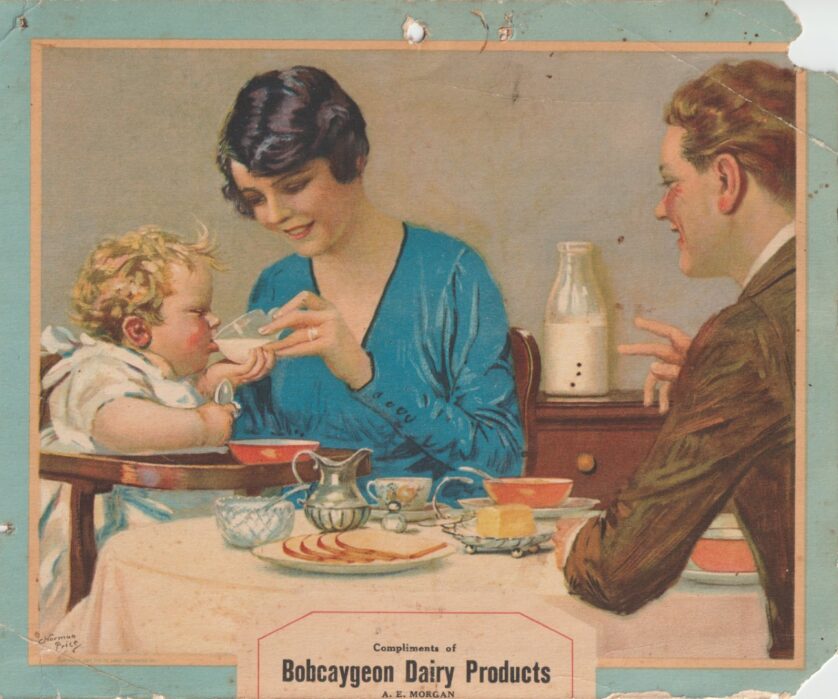
By the 1930s, Bobcaygeon was home to three dairies, which were run by the Johnson, Murphy and Coulter families, plus the Bobcaygeon creamery that Charles Elliot built on the west side of Bolton Street, south of King Street (the site is now Canada Post). In 1937, Jack and Ila Crowe moved to Bobcaygeon and purchased the Johnson’s dairy, while George and Susie Lee acquired the creamery, which they operated as Bobcaygeon Dairy Products. Murphy’s dairy sold raw (unpasteurized) milk and after pasteurization became mandatory, the Crowe’s Kawartha Dairy was the only dairy in town. Kawartha Dairy sold milk around Bobcaygeon, while the Creamery made butter, so farmers could sell their milk to Kawartha Dairy and their cream to the creamery. It saved farm families a lot of work to have the creamery process large batches of butter, rather than dashing their own butter by hand.
This story is a memory and nobody’s memory is perfect. Sometimes details get a little mixed up, things get forgotten or overlooked, and the perspective is inevitably subjective. If you notice something that not right, have something you would like to tell us, or a memory to share the museum would be happy to hear from you: [email protected]
This story is part of our partnership with Maryboro Lodge, The Fenelon Falls Museum and was written by Glenn Walker. .
If you want to make a donation to the museum, you can e-transfer to: [email protected] or mail a cheque to :
Maryboro Lodge Museum
Box 179
50 Oak Street
Fenelon Falls, ON
K0M 1N0