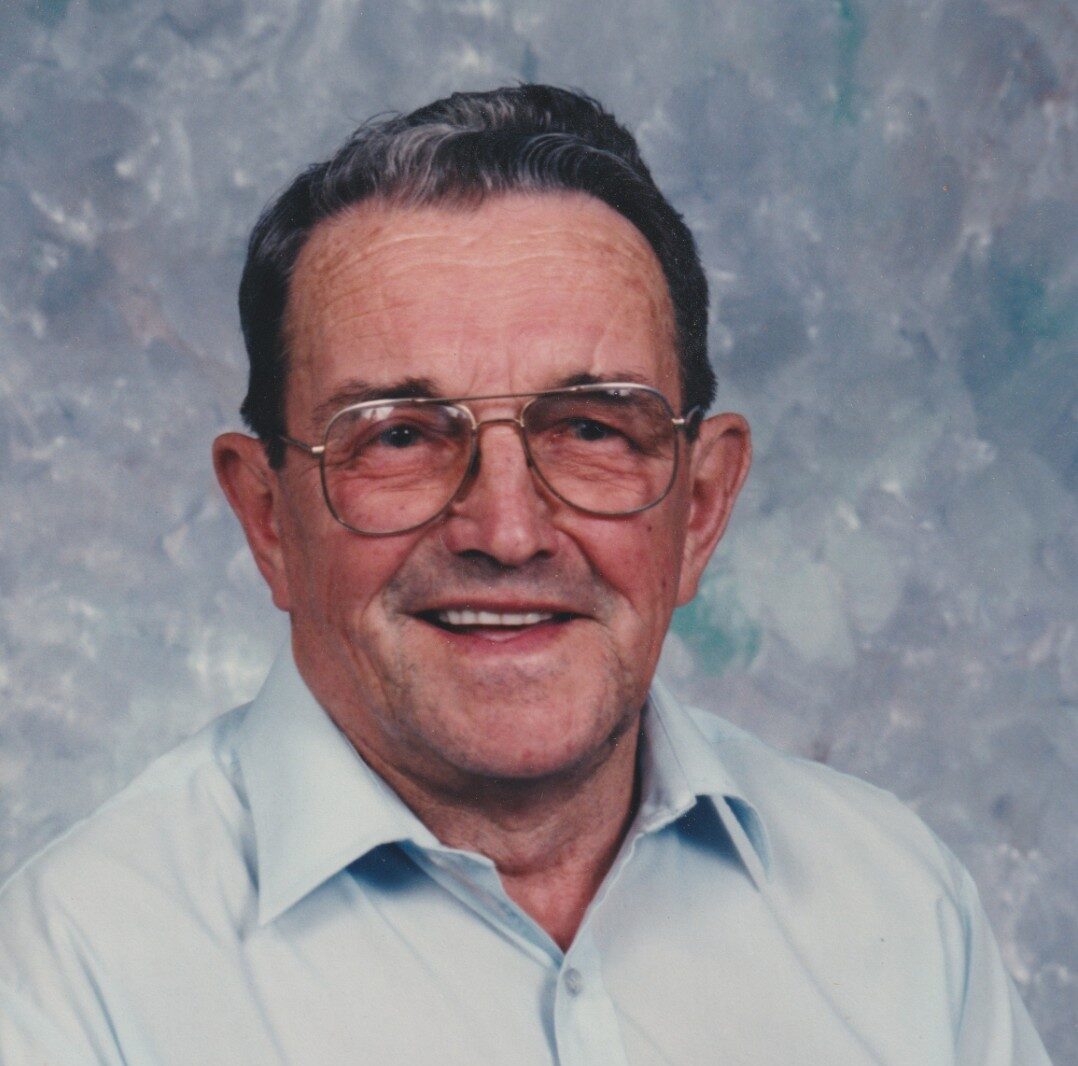
With excerpts from Chester’s Legacy Book, written 2000-2001.
KAWARTHA LAKES-When Chester Godwin was born at Burnt River in 1917, it was a village that had grown around the railway and for many years, the largest employer was a limestone quarry located right beside the tracks south of town. Within a few years the quarry closed, and the village continued to be surrounded by family farms. Many families sold sawlogs, fence posts and pulp wood to help make a living. In Burnt River, the 1920s were not the “Roaring Twenties” associated with city life—many families had precious little beyond necessities. Chester became an adult during the Great Depression.
Chester’s father, Frederick Godwin, was a section man at Burnt River for the Canadian National Railway.
“In the winter there was only two men working the section: Foreman and Dad. In the summer they had one more man. They were kept busy, replacing rails, replacing ties, and packing them, keeping the rails even with shims so it was not rough for the trains. Any kind of work interested a person, if you could make a few pennies, but his job was hot back breaking work with square mouth short handled shovels to pack the ties with. No wonder they all had bad backs.” Though it was physically demanding work, at least he had a steady job, which was security that many other families would not enjoy. Making a living on a Burnt River farm in this era was back breaking too.”

His family also looked after the village public school, which was located in a stone building, just north of the intersection of the main street and East Line Road (now a private residence). Minerva Mae (Minnie), his mother, “tried to keep it clean, she swept it every night, cleaned the blackboards and it had to be scrubbed every week, that was a chore. She done the work at the house to keep it clean, meals to feed five kids, keep their clothes clean, and keep peace among us. At that time, I do not think we realized how fortunate we were to have a mother like that. Some of us think of it after it is too late.”
Though both of his parents worked, money was tight for Chester’s family. For two weeks of hard work on the railway, Frederick earned about $40 to $45 bi-weekly, while his mother received $5 per month for looking after the school. “With five kids to feed and clothe, the money had to be stretched pretty thin.” All of the kids were expected to contribute. Chester would help carry in water and wood. “I had the cows to clean out and keep fed (winter).” In winter, he would have to lead the cows to water and chop a hole in the ice with an axe so they could drink. He would curry comb the cows every day—to keep the cattle clean and reduce the number of parasites.
“We never went hungry and were always warmly dressed, so I think our parents did a good job.” For kids in that era, having clothes that kept up with the latest fashions was just not realistic. For pleasure, they might be able to go for a sleigh ride, or skate on an outdoor rink that they maintained themselves. Looking back on his childhood, Chester fondly remembered his mother’s bread, buns and pies—the homemade treats that a mother lovingly made, were a big part of what made life special.
For local families in the 1920s and 1930s, meals were often very repetitive. At the Godwin home it was typically potatoes, turnips, vegetables and pork. They would pick their own fruit—which was a time-consuming job, but a very enjoyable one because it was such a treat to have fresh fruit. During their summer holidays, when the strawberries ripened, “we would be given a honey pail and go with mother to the bush, then the raspberries would be ripe so more picking, come home and hoe the potatoes, in the summer we had lots of beans, radish, onions and other vegetables to eat.” His family raised chinchillas for meat, and also sold their hides. Generally, their diet was “what you grew yourself and what you put away and preserved for the winter.”
All the kids in town would go to the village school that Minnie maintained. For public school, all eight grades received instruction together from one teacher, and class sizes could be quite large, with all the village students attending. When this school first opened in 1901, there were 108 students, spread over eight grades with just one teacher to look after them all. In Chester’s 1928 school picture, there were 39 students present that day. Older pupils had to help younger peers with their lessons. One of the most popular recess activities was baseball, because all students, young or old, could have a turn at bat. “It was softball, and I was the pitcher, because I was left-handed.”
The teacher’s personality shaped the students’ experiences. Jim Wood was a memorable teacher, that Chester remembered for his strictness, “he was awful stern and cross. … If we ever did anything to have some fun, he would have his fun making us roll our shirt sleeves to our elbows, and he would give us the strap. Our arms would be black and blue. I remember one strapping he gave Leonard and his arms were so black and blue in two or three days they were just like jelly, his arms were so badly bruised. I know they had a special school meeting about that.”
Often the teachers could be quite young, many were scarcely older than some of the students they taught and it was customary that women would retire to have a family if they were married. “I remember one young teacher and doubt if she would be more than twenty. I would be ten or eleven, the first morning of school, she lined us up outside, for us to march in. She was wearing, I think they called them a butterfly skirt, a gust of wind came and blew it up over her head. Everybody laughed and made fun of her. I expect I was as bad as the rest. I guess we kept teasing her, for she only lasted about a month and she left. I never heard if that was the end of her teaching or not, but I often wondered if we were the cause of giving up her career.” For a young teacher starting out, there was no support—they walked into a school, by themselves, and were responsible for all the students. Teachers typically worked on a contract, and many only stayed for half a year or a year at one school.
In winter, skating and playing hockey were favourite recess activities, and Mr. Wood, though remembered for his strict discipline, often let the kids play a few extra minutes. The students would travel down to the beaver meadow (located west of the school, near the current baseball diamond), which they might clean off before school, so it would be ready for recess, when they enjoyed a game of shinny. They later built a rink beside the Handley home. “Handleys had a Delco Plant that supplied their house with lights, so we were able to put lights on the rink and play at night. Then after hockey, clean the rink and flood it by hand, get home about two in the morning.” (A Delco plant was a generator that charged batteries, which were then used for lighting or powering appliances before homes were connected to the electrical grid.) Later on, the community came together to build a rink in the hollow north of Ralph Sheehey’s.
“When I was young, we used to go fishing, an odd night when I think I got home from school, mother would say how about fish for supper, so we would go to the garden with a shovel and can to get some worms and try to catch a few grasshoppers on the way to the river. It did not take long to get a couple of good-sized fish, we always threw the small ones back. We used to go swimming quite often, down to Reed’s flat. I remember one day five or six of us boys went skinny dipping. Garnet Budd and I was on the far side of the river, some girls came over the hill yelling. Garnet swam back, but I stayed and got Grace Campbell to swim out with my trunks and I got into them under the water.”
For as long as he could remember, Chester’s best friend was Ray Handley. The boys grew up together, and throughout their lives would remain best friends: “We were together from before school life, we went to dances, people always said if they saw either one of us, they knew the other one wasn’t far away.” Ray’s father, Joe ran saw and shingle mills, and later purchased a planing mill in Fenelon Falls that would become Handley Lumber, now in its fourth generation.
As Chester was growing up, kids typically relied on their own imagination or ingenuity at play time. “We were lucky to get one toy at Christmas, what we played with we pretty well made ourselves. There was a ditch down past our place from the corner to the beaver meadow. We had a sand pit in it, about straight out from where Tom Handley’s house is now (160 Hillside Drive, opposite the ball park, which was beside Earl Godwin’s home (#162). The logs for Handley’s mill were stacked behind Tom’s home), about eight or ten boys would play in the sand there, with our little wagons we had made ourselves. I guess we lucky enough to have that much.” He elaborated, “After we got our chores done, if we had time, if we could find some small pieces of lumber down around the sawmill and scrounge a few nails by pulling them out of something else, we would try to build a wagon or sleigh or whatever came into our mind.” His friends called him “Chester Gump,” after a character in the comic strip The Gumps, which ran in many newspapers in that era.
During Chester’s childhood, having a book was a special thing. Children would have the chance to read at school, but might have precious few books at home. His family subscribed to the Family Herald, which was a popular national newspaper, published by the Montreal Star. Much of the content was related to agriculture, but it also ran short stories and poetry. Chester’s favourite part was “the Song of the Lazy Farmer.” One week there was a special offer of two books, in exchange for selling subscriptions, which enticed Chester. It was very exciting when he received The Adventures of Huckleberry Finn and The Adventures of Tom Sawyer, and he read them “I do not know how many times.” Later in life, he would say that these two books were his most treasured possessions.
When he was a boy, Chester’s family did not have a car, and felt fortunate “to have a horse and buggy.” In the mid 1920s, he could only remember five people in Burnt River who owned a car. “I guess they were what you would call ‘the Upper Class.’” His family also did not have a camera and “the only photos we had were if someone gave them to us.” In that era, memories were kept as neighbours would gather together and share stories—often about the memorable characters in their community. The Godwins would only have the horse and buggy for one summer. “Our stable was not big enough to keep it and the two cows. Given the cows were more important than the horse, there was seven of us and one buggy, that would hold three or four if they were small.” So much of the time, “the only way to go would be to walk. … I think we fared as good as most families at that time.”
“The only [musical] instrument I learned to play was the radio. If I remember right, it had a B battery and two C batteries, three dials to tune in the program and a big horn that sat on top of it.” In this era, families would gather in their living rooms to listen to the radio together. They typically had to be selective about which shows they were going to listen to, because they didn’t want to use up their batteries. Gene Autry, Dale Evans and Roy Rogers were much loved country singers. Beginning in the 1930s, National Hockey League games were broadcast, which many families looked forward to hearing. Initially broadcast by other stations, CBC’s Hockey Night in Canada with Foster Hewitt became a Saturday night tradition. Foster Hewitt had a cottage at Beaverton, and later in life Chester would have the pleasure of serving him at Handley Lumber, along with his son Bill Hewitt (also a CBC personality) and goaltender Gump Worsley.
When Chester was a boy, many families kept an animal or two for their own needs, even if they lived in town. Practically every family tended a vegetable garden. “We had animals, two cows, Daisy and Molly, we had goats for milk for Dad. I had a big black goat, and I called him Billy. I had a set of dog harness for him. I would try to hook him to a sleigh and he could even run. If I went to the store with him, you would have to tie him up or he would go right back home.”
Though they had a few animals of their own, Chester loved to visit neighbour Chris Hodgson to help with the chores. People made their own entertainment, which often just consisted of spending time with those around them. Though he had his own chores to do at home, it was something different to help someone else with their work: “Getting hay down, feeding the cattle, horses, sheep and pigs, but thinking back, I was likely more in the way than helping. They had three boys, I would think, they would be about ten years older than me, but they were like their Dad, full of hellery and always playing tricks on me.”
At Hodgsons, “I remember they had two or three cats, they would sit behind the cows when we were milking, and we would squirt the milk towards them. They would sit there and open their mouths. I am sure there was more milk outside of them than inside. I used to enjoy going to Fred Palmer’s. They had a big milk separator. I was not big enough to start it myself, but when they got it up to the right speed they would let me turn it till we got finished or my arms got tired”
Every year, when Chris Hodgson’s lambs were born in the spring, there might be one or two that the mother would not feed. He gave one to Chester’s family and they would bottle feed it with cow’s milk. Before long, it would become a nuisance for Chester’s mother. “It would follow her wherever she went, all through the house and up the stairs right at her heels. She would try shutting him out till she got something done, but he would stand at the screen door blatting till she would have to let him in, when it came fall and time to have the sheep sent to the stock yard for sale and time for my sheep to be killed, I had to take it back to Hodgson’s and pick over another one to kill for us. Mother always said she would not be able to eat the meal if she thought it was the one she raised. She was always very kind and gentle, you could not help but to love her.”
Chester’s enjoyment of helping on the neighbouring farm turned into his first job, at age 11 or 12, “working for Chris Hodgson at 50c a day. Alf Hodgson was a Lindsay policeman, said he would buy me a bike and I could pay for it while working for his Dad. It was BSA made in England and cost $15.00 so I had it paid for in one month, he told me what day he would send it up on the noon train. I was here waiting for it. I could not try to ride it over the [railway] ties, so had to walk with it up to Fred Palmer’s crossing, then try to get on it. I do know how many times I fell off, by the time I got to Chris Hodgson’s, I was able to stay on it. What a thrill. My own bike.” It was exciting to have a bicycle, a step towards independence, being able to travel further and faster on his own, than by walking.
The village’s churches were a huge part of community life, and practically everyone went to church. Chester’s parents were members of different churches, which was unusual for the time. In practice, this meant that the children went to both churches, which met at different times. Frederick sang in the choir in both churches, while Minnie played the organ at the United Church. “Every Sunday morning at ten o’clock the Anglican church had Sunday School. Church was eleven o’clock every other Sunday. The other Sunday it was at 7:30. The United Church Sunday School was at two o’clock and the church service was at three o’clock. So, we got lots of church. I do not know how much good it did.” When the time came, Chester joined the Anglican Church, and his mother was graceful about it, “as long as we went to Church and believed what we were going for, she didn’t care which church we belonged to.”
Chester was given a job to go to the shovel the snow at church on Saturday and then start the fires on Sunday morning so the building would be warm for service. When the minister arrived, Chester would unhitch his horse, put it in the stable and feed it. Then after church he had to hitch it back up so the minister could leave. Once a year he would go to the vestry meeting and be paid a five dollar bill.
Later in life he became a lay reader, and if the minister could not attend, he would read the service at St. Luke’s Anglican Church. He was also very involved with the masonic lodge in Coboconk. He was the installing master for 50 years. “He sat downstairs and spent hours memorizing everything that he would have to say at the Masonic Lodge,” his daughter Marian Ann recalled. “He expected other members to memorize their materials too.”
Chester grew up with an expectation that he would faithfully say his prayers. “I had to kneel at mother’s knees, say my prayer.” His mother taught him to slowly and thoughtfully say: “Now I lay me down to sleep. I Pray the Lord my soul to keep. If I should die before I wake. I pray the Lord my soul to take. Amen.”
On Christmas morning, the kids would wake up early to see what was under the Christmas tree: “You were lucky if you got two or three things, but we always had to keep one to open when we came home from Church. The school always had a play, that everyone had a part in. The Sunday School each had a play, then the community had a play, that was held in the Orange Hall, always a big Christmas Tree, well decorated. Tom Suddaby was usually the chairman [and] for that [there was] usually a little book of some kind and a bag of candy. I think they came from T. Eaton Co. or some of it did. We were more anxious to see what someone else got than what we got ourselves.” Tom was still reading the (often lengthy) program when Chester’s daughter Marion was in the school.
Chester would never forget when he had his brother Leonard (Chink) received bob skates for Christmas. His parents “hid them in a trunk in their bedroom, or thought they hid them, when we got home from school and mother left to clean the school, we would get them out and strap them over our boots and make out we were skating around the upstairs. I do not think they could help to know, for there must have been marks on the floor.”
In the 1920s and 1930s, people really looked forward to community events like the Kinmount Fair. One year, Ray came to invite Chester and Chink (Leonard) to go to the fair with him and his father. On Saturday morning it was the Godwin boys’ job to clean the chinchilla pens and change the straw. Their mother said they could go once their work was done, but that day they cut a corner and just put straw over the old straw. When their father got home at noon, “we went out to check out work. We never got to the fair, but redone our work. He did not yell at us or anything. I guess he figured we were punished enough when we had to stay at home.”
Burnt River residents would gather at the Orange Hall for dances. In the late 1920s, “butterfly skirts were all the rage. Us boys would be sitting on a chair along the wall. The men would swing the girls so their skirts would be straight out at their waist, we would all giggle and the older ones would yell and clap. In those days it was something to see.”
For the Burnt River dances, the music was typically played by members of the community and the genre was what would today be called Old Time. At one dance, “George Schell was playing the violin and he broke a string on it, so he sent someone over to Wright’s store to get a C string, but they didn’t have one. So he sent them back two empty cans. I do not know how he got a hole in the bottom of them, but he took another string off the violin and strung it between the two cans, put one can under his arm and held the other so he could put tension on it, used a pick and he could make music with it, so we had music with it and the piano.”
When Chester was about five or six years old, around 1922 or 1923, Frederick took him to a political meeting at the Orange Hall, where he had the chance to meet Thommy Stinson (Member of Parliament for Victoria from 1925-1935). For Chester, it was a very memorable event, having the chance to meet such an important figure. “After the meeting he came down off the platform and was talking to Dad. He patted me on the head and said what a good looking boy I was, then asked me if I would like to carry his books out to the car. I expect I felt very proud to be asked. When we got to the car, he reached in his pocket and gave me all the change he had. I do not know how much it was, I expect about a dollar. I guess that is why I am still a Conservative. …. Politicians have never changed.”
Once he finished public school in Burnt River, he had to leave home to continue his studies. Burnt River did not yet have a continuation school, as High School was then known. He moved to Lindsay, where he roomed with Harvey and Philip Johnstone in an apartment on Cambridge Street North. Being a fourteen or fifteen year old boy, “we had to make our own beds, get our own meals and keep the place clean. It did not hurt us one bit, likely it did us some good.” He had the chance to learn practical subjects that were not taught in public school like commercial, shorthand, typing and bookkeeping. The only extracurricular activity he remembered having the chance to enjoy was football.
Chester’s high school experience was brief, because his family could not afford to have two children boarding at the same time, “at the height of the depression.” Leaving school meant getting a job.” You knew when you got out of school, you went to work, if you were lucky enough to get a job, that was in the Dirty Thirties.” Chester was ready to enter the working world, “so it did not take much talking to get me to quit.”
Chester’s first job as a young adult was helping to build Highway 35. To provide relief for unemployment during the Great Depression, the Province undertook public works projects. “Three of us went in the winter of 1933, and were sent to camp #28 this end of Twelve Mile Lake, at the Red Umbrella [Inn, near Carnarvon], a long way from home. The kind of job was a wheelbarrow and short handled round mouth shovel, a pick axe and take and dump it to fill the hollows to level the road. It was a backbreaker. We got rich in a hurry. We were to get five dollars a month and our board, but when they paid us, they took fifty cents a month off for doctor bills if we went to the doctor or not, so we got four dollars and fifty cents. Hardly enough to buy tobacco and papers.”

While he was working in the government camps, they stayed in barracks that were about “20 feet wide and about 40 ft long, with double bunks down each side. There were enough beds to hold about thirty men, two men to a bunk, with top and lower bunks. It was a scramble to get up in the morning and try to get washed before breakfast at 6:30. A lot of us younger ones would go and jump in the lake. Pat Conway was the cook, and when he banged the iron to call us for a meal, you wanted to be there in a hurry.”
After working on Highway 35, Chester went to work for his best friend’s dad, Joe Handley in April 1934. “Ted Phillips got the team ready on Monday morning, hitched to a rubber-tired wagon. The first one in the County. Angus Campbell and Bill Rettie and I headed out for Swamp Lake, Crystal Lake now, where Joe Handley was having a sawmill built. Austin’s had a sawmill at Dettman’s Hill, but they had the logs around there cut, so Joe Handley bought the mill or what was left of it. We loaded it or what we could on the wagon and took off for Swamp Lake. I should say Dettman’s Hill was close to a mile off the Galway Road on the Lower Swamp Lake Road. When we got to Dalton’s Hill, we had to unload half the machinery, take what was left to the top of the hill, unload it, come back down and get what was left, go to the top of the hill, load it up and go on. Going up the hill, we had to block the wagon wheels so the horses could stop to get their wind.”
Working for a lumber company, Chester joined many of the other men to work in a logging camp in winter. For most young men working in the camps, they made many happy memories together, with a little ‘hellery’ every now and then. “The first winter I was in a logging camp Earl Young, Ray and I stayed at Bill Sawyer’s Camp while we were building the bunk house, cookery and stable at Deer Lake. Earl had a cold, so Bill Sawyer got out a bottle of Sloan’s Liniment (a popular heat rub used to treat muscle stiffness) to put two or three drops on a spoonful of brown sugar and this was to help the cold, we each had a dose. Bill said he would have the same, we soaked it and he nearly choked to death, we could not keep his cup full of water, that scared all of us.”
By the late 1930s, trucks were starting to become common and made it far faster and easier to move loads of logs from camps to the sawmills. Once trucks appeared on the scene, the era of driving logs down rivers came to an end. Joe Handley would travel around the countryside buying logs from farmers, which he could then cut at his mill. Many farm families made a living in the winter cutting their own woodlots. Chester worked for Joe as a truck driver.
One day in April 1938, Chester spent the whole day in Lindsay getting the truck serviced, and ended up being late to meet his date for a dance in Kirkfield. By the time he arrived at 9 PM, she was dancing with someone else. But it proved to be a blessing in disguise, because he met Leila Marian Otto, who was also there alone, and Chester offered to drive her home at the end of the night. “It took a lot of coaxing,” but they became friends, and would be married for more than 60 years.

After Chester and Marian married and his daughter Marian Ann was born in 1940, he decided to enlist in the military, as the Second World War was raging. The young family travelled to Toronto, where they spent a week in Toronto, and Chester offered to serve his country. He tried the Air Force, then the Navy, then the Army, but was turned down by all three in the fall of 1941.
“In 1943, I got a letter from the Government, telling me to report to their office in Peterborough and to bring my rejection papers with me. They were the first things they asked for and I never saw them again. I was stationed in Peterborough, Kingston, Cornwall, where I was an instructor for the Bren Gun. I asked to go overseas, so they sent me to Kingston. I was to go overseas from there, but they sent me to Debert in Nova Scotia [Debert Military Camp was a military base alongside Royal Canadian Air Force Station Debert], but they would not send me overseas on account of my stomach. I was on staff there in the officer’s mess, till the end of the war. Then I was sent to Niagara on the Lake till I got my discharge.”
When the young family returned to Burnt River, they initially lived in the house attached to Suddaby’s store. They already had new furniture including a bedroom suite, kitchen furniture, a stove and couch, but there were many other things they needed to start their household together. Chester’s employer Joe Handley asked Marian to “make out a list of what we needed, he would look it over and if he approved, he would pay for it. He said we sure didn’t ask for anything we didn’t need.” Marian wrote it on an Eaton’s form, and Joe paid for it, deducting $5 from Chester’s pay cheque biweekly to pay it off.
When he got out of the army, he wanted to buy his own truck so he could continue working for the Handley company. Joe Handley died in 1945, then the company passed to his wife Mattie, then son Ray. Chester managed to put together enough money to pay for the truck, which was a big investment for him. He would later call it “the gutsiest thing I ever did.” But he would go on to work alongside his best friend Ray for the rest of his working life—customers would long remember seeing them together in the small sales building at Handley Lumber. After Ray passed away in 1999, Chester would think about his lifelong companion every day.
As Chester was taking the plunge to invest in a truck, he also needed to make a permanent home for his family. In 1944, a great fire had destroyed homes and businesses on the west side of Burnt River’s main street, north of the train tracks. Chester bought one of these lots from Tom Suddaby. He went to talk to his employer, Mattie Handley, and agreed to buy three unused buildings at a Tory Hill mine for $500. With Bud Otto and Bob Cameron, he disassembled them and reused the materials. Marian helped by straightening the nails so they could be reused. They cleaned the debris from the fire out of the basement, so they could reuse a foundation. Carpenter Angus Campbell took the materials they had salvaged and made a building that would last.
Purchasing a truck and a house at the same time was more than Chester could comfortably afford, so he asked Marian: “If we build a house and store will you look after the store?” Marian agreed, and would faithfully care for the store, even after Chester had passed away. She worked there for more than sixty years, almost until she had to move to a nursing home. Many local kids would fondly call her “Pud,” (All of her brothers and sisters had nicknames, Pud was her childhood nickname) as they visited Godwin’s Store. Any time that anyone came to the store, Marian would quit what she Fmarwas doing at home, so she could serve them.
Daughter Marian Ann describes the family business: “The store was on the left side of the building, where the big two front steps were located. The living portion was on the right side of the house. It was a very plain store, with the merchandise on simple selves. On the left side was the old Coca Cola cooler, which was later replaced with the ice cream cooler. On the right side was the counter that had been salvaged from John Handley’s store during the fire of 1944, and then a second counter for meat. The first ice cream we sold came from Acme Farmer’s Dairy in Toronto. It came by train along with popsicles, that were in a brown fabric case, that looked like it came from the military. Those were the days that a big scoop of ice cream was a nickel. Dad would get it out of the station, unpack it from dry ice and put it in the freezer. We did that until Silverwood’s Dairy (of Lindsay) began to deliver. In later years, Kawartha Dairy delivered to our store.”
“In early years, Mom kept a bill for each customer that they would pay at the end of each month. Later on, as customers became used to paying cash for each transaction, they would just pay for the purchase at the time. Before cottages had refrigerators, ice was cut on Four Mile Lake. Every Thursday, Friday and Saturday night we would go on a delivery run—there were 90 cottages we served on the lake. After supper, we would load the car so we could deliver groceries and ice to the cottages. Then times changed as practically everyone had a car and customers would just stop by the store. In later years, we would go to National Grocers to buy the food that we resold at the store. Mom always applied a 15% markup.”
Having grown up in the Great Depression, both Chester and Marian understood what it meant to do without, and spent their lives working hard to look after their families. After Chester had a heart attack, he found it very hard to see Marian working, when he could not help her. The young couple that met at the dance where they were both alone, would stick together and faithfully be there for each other. When asked about why their marriage succeeded, Chester explained, “you have to be committed to one another, each take your own share of the work there is around the home, and this is what you call love, if you do not have that you have nothing.” Working in a lumber yard and operating a Burnt River store, their lives were a lot of hard work, but they would not say that they would want it any other way. “We always seemed to be satisfied with our lot in life.”
This story is a memory and nobody’s memory is perfect. Sometimes details get a little mixed up, things get forgotten or overlooked, and the perspective is inevitably subjective. If you notice something that not right, have something you would like to tell us, or a memory to share the museum would be happy to hear from you: [email protected]
This story is part of our partnership with Maryboro Lodge, The Fenelon Falls Museum and was written by glenn walker. .
If you want to make a donation to the museum, you can e-transfer to: [email protected] or mail a cheque to :
Maryboro Lodge Museum
Box 179
50 Oak Street
Fenelon Falls, ON
K0M 1N0