KAWARTHA LAKES-“The old adage, ‘it takes a village’ is never more evident than at the August long weekend at the Burnt River Park,” Ruth Handley observes. “For the past fifty years Burnt River has been home to a mixed lob ball tournament. The longevity of the tournament is a testament to the community’s many volunteers. Our volunteers, driven by big hearts, hard work, commitment and huge community spirit have enabled the tournament to grow and thrive.”
The little tournament had humble beginnings in 1976 with just three teams participating. Local volunteers wanted to raise money for new uniforms for the Burnt River men’s fastball team. Beth Handley had the idea of inviting two teams from her work at the Bank of Montreal in Toronto to play ball and after a lot of smack talk between the participants the challenge was accepted. “Beth Handley’s coworkers at the Bank of Montreal in Toronto boasted they could teach a country hick a few things about the game of baseball,” remarks Erick Watson. “But, they definitely were not the Blue Jays!” A dance was held at the Galway Hall on the Saturday night that also acted as a fundraiser—the Burnt River Community Centre did not yet exist. Attendence exceeded hall capacity. “The Toronto teams all stayed at the Handley cottage.”
“It was an excuse for our friends to come up for the weekend,” Beth recalls. “Burnt River had a team, and there were a bunch of our friends from Toronto that called themselves the TO Bullies. I had started working in the Bank of Montreal’s data centre in Scarborough, and we entered a team too. There were a lot of young crazy single people on those teams. We played ball on Saturday, there was a dance that night, and then we played a few games on Sunday. It was such a good time. Everyone could say that they won the tournament, because there was not a final game. It really was just an excuse to have people get together, and have a dance.” Erick adds: “The identity of the first championship team is still hotly debated, but the home team, however, still claims the victory.”
“The dance was at the Galway Hall, and the attendance exceeded the capacity,” Beth continues. “It was to raise money for the baseball shirts. It was back before the foundation was replaced under that building, so the floor would bounce up and down as people as everyone was jumping up and down to Thank God You’re a Country Boy. That was the only song that was banned, because the floor was bouncing too much.”

“The tournament has always been slow pitch, with 5 girls, 5 guys on each team. It has always been on the Civic Holiday weekend.” When the tournament was founded, the ball park was still being redeveloped. “In 1976, it was basically just a vacant lot. The men’s fastball team had made a little bit of an infield. The backstop was made out of snow fence, and there were a few benches for players to sit on. But there was no outfield fence. You could hit the ball as far as you could, and the outfielders could run as far as their legs would carry them to catch it. You actually had to run to get a homerun.”
Before becoming the ball park, the lot had been the site of the Dancey sawmill. “The lumber had been sawed in a building that was like a drive shed, with a metal roof. There was another shed near where the swings are today, that was used for storing mechanical parts. Where the fence is today, they stacked their lumber—there were rows of railway ties, 2x4s and building lumber. As a kid growing up nearby, I remember laying in bed and hearing the saw in the 1960s. I loved the sound of it, hearing the lumber going through the mill. By the time I can remember being in the building, it was a little dishevelled and the engine was out of it.”
“In 1972, this property of 18 ½ acres known as the Dancey Sawmill came up for sale,” Erick recalls. “Six community residents banded together, went to the Bank of Montreal and borrowed $5000 to purchase the property.”
“At this time, the Burnt River and District Recreation Association was formed,” Erick continues. “Work started to raise money to pay back the invested residence to pay off the loan at the bank. After many auction sales by Monty Robson, dances, card parties and disc jockeying at various parties in the area, the loan was paid off and in 1973 the property was deeded to the Township of Somerville to enable the community to obtain insurance and federal and provincial grants.”
“Local volunteers applied for some youth employment grants to help clean it up,” Ruth recounts. “It was great, because it employed youth from the community and improved the park.” Beth adds: “There were a lot of old buildings and the slab piles. For 2 or 3 years, local youth worked in the summer to clean it up.” Erick elaborates, “A small storage shed on the property was revamped for meetings, card parties and New Year’s Eve parties. Then a playground was built with the largest slide in Ontario, which by the way had to be demolished because of its size 20 years ago.”
“In 1976, a cement pad was poured serving as a tennis court in the summer and an ice rink in the winter, as well as hosting dances and corn roasts,” Erick says. “Broomball tournaments were held playing for the golden funnel. At this time the Bullies Stadium was constructed by many volunteers. One of the best grader men known as ‘High Blade’ brought his grader and did the levelling of the field. Also, another volunteer who worked at a rental shop brought a two-roller packer to make sure the field was level.”
“To construct the Community Centre, the volunteers applied for and received a Wintario Grant,” Ruth says. “To get the grant they had to transfer the property to Somerville Township and they had to raise matching funds–$100,000. It was quite an accomplishment for Burnt River to raise that much money.” Beth adds, “When the building was built, the team put the bar in and the floor. That’s why there is a bull in the centre of the floor.” The Burnt River Community Centre was completed in 1983.
“For the second year, it was more of an official tournament,” Beth notes. “Some fastball teams in the area heard about it and wanted to participate. I think there were six teams the second year. The new teams were Kinmount, Norland and the Bank of Montreal entered a second team, the Beer Soppers. In the years that followed the tournament continued to grow. For two or three years, the dance was at Log Chateau. That became the place where people that didn’t have cottages camped. It was a busy weekend there.”
“The women of the Burnt River Bullies became the organizers, because it quickly became clear that the men weren’t organizational wizards,” Erick explains. “Having only one diamond in the beginning, the funds from the entry fees were used to improve the existing diamond, all maintenance repairs and improvements were the responsibility of the Bullies.”
In the early years, Beth explains “guys would volunteer to be the umpire, and girls would do the scorekeeping.” Erick elaborates: “For many years, the games were umpired by volunteers, but after a number of disputed calls and heckling that the umpire is blind (which we were) we had to hire official umpires to oversee the competition. Scorekeeping was managed by volunteers. Scorekeeping is now the responsibility of each team. Even though there are no cash prizes, everyone is still very competitive.”

“The beer tent volunteers stock the beer tent and unload the beer trucks, sell tickets and serve beer helping to keep us all in good spirits,” Erick notes. “In the beginning, we used to fill a red canoe with ice to keep the beer cold. We did discover the brand of beer not to order. One year Amstel wanted to support our tournament, so we paid for 115 cases of 24 bottles. The following Tuesday we had to hire a truck and return 98 cases of 24 bottles of beer for a credit.”
“A number of years ago, our volunteers perfected serving breakfast to 300 people, cleaning up, playing ball and reporting back for duty as ticket sellers and bartenders for their infamous dances,” Erick remembers. “Thank goodness for the Burnt River Fire Department for serving their delicious egg, cheese and peameal on a bun to this present day.”

Ruth continues: “The recreation committee brought in an old building that they operated as a snack shack. They built an area for barbeques, which helped raise funds over the course of the weekend at the snack shack. In 2005, we put up a new backstop and extended the fences on either side of the diamond, so throws coming in wouldn’t hit spectators.”
“As the tournament grew so did the need of organization and field construction,” Ruth narrates. “In the beginning, Bill Handley gathered a crew to construct fences and diamonds each year. Volunteers took on scorekeeping and umpire duties, along with field maintenance and pouring the odd beer. The original cooler being a canoe filled with ice.”

Within a few years, the tournament had grown sufficiently that we created another ball park. Beamish sent up equipment to roll it for us. For a few years, the tournament reached 64 teams and we needed three ball parks. So, Tom Hodgson let us use his pasture that we called ‘Cow Paddy Park”—we played in his pasture field for the weekend, with a temporary back stop.” Erick adds: “Ray Handley let us use his land for the ball field called Calf Pen. Cow Patty Park was a cow pasture right up until the day before the tournament, so many players can attest to the fact that it was appropriately named. The tournament grew to its maximum of 64 teams with four fields in operation.”

“The Pigpen ball field was constructed some years later by a group of volunteers who unearthed old lumber, tires and what may be the remains of an old truck,” Erick says. “For the first time all games would be held in one area and the number of teams would increase. In 1987 the Bullies were able to fund an official backstop and outfield fence on the main diamond and a temporary backstop was constructed that same year at Calf Pen and Pig Pen diamonds.”
“Even when there were 64 teams in the tournament, we still had a waiting list,” Ruth explains. “One team used to come from the United States. Now they come from as far away as Kingston and London. Now there is a trophy for the winner—they take their picture with it, but they don’t get to take it home. But there is no monetary prize.”
“For years, the dance was packed and it was one of the major money makers.” Beth notes. “But it petered out about twenty years ago. Once the community centre was built, they started hosting breakfast on Saturday morning. Teams that played early in the morning would come in and have their breakfast. Then we worked to make sandwiches for the dance that night. Play ball, look after the beer tent, get ready for the dance, then clean up after it. A lot of volunteer hours went into the ball tournament. There is still the beer tent. The Kinmount Legion looks after the snack shack and the fire department makes breakfast. Some of the players still stay at Log Chateau for the weekend.”
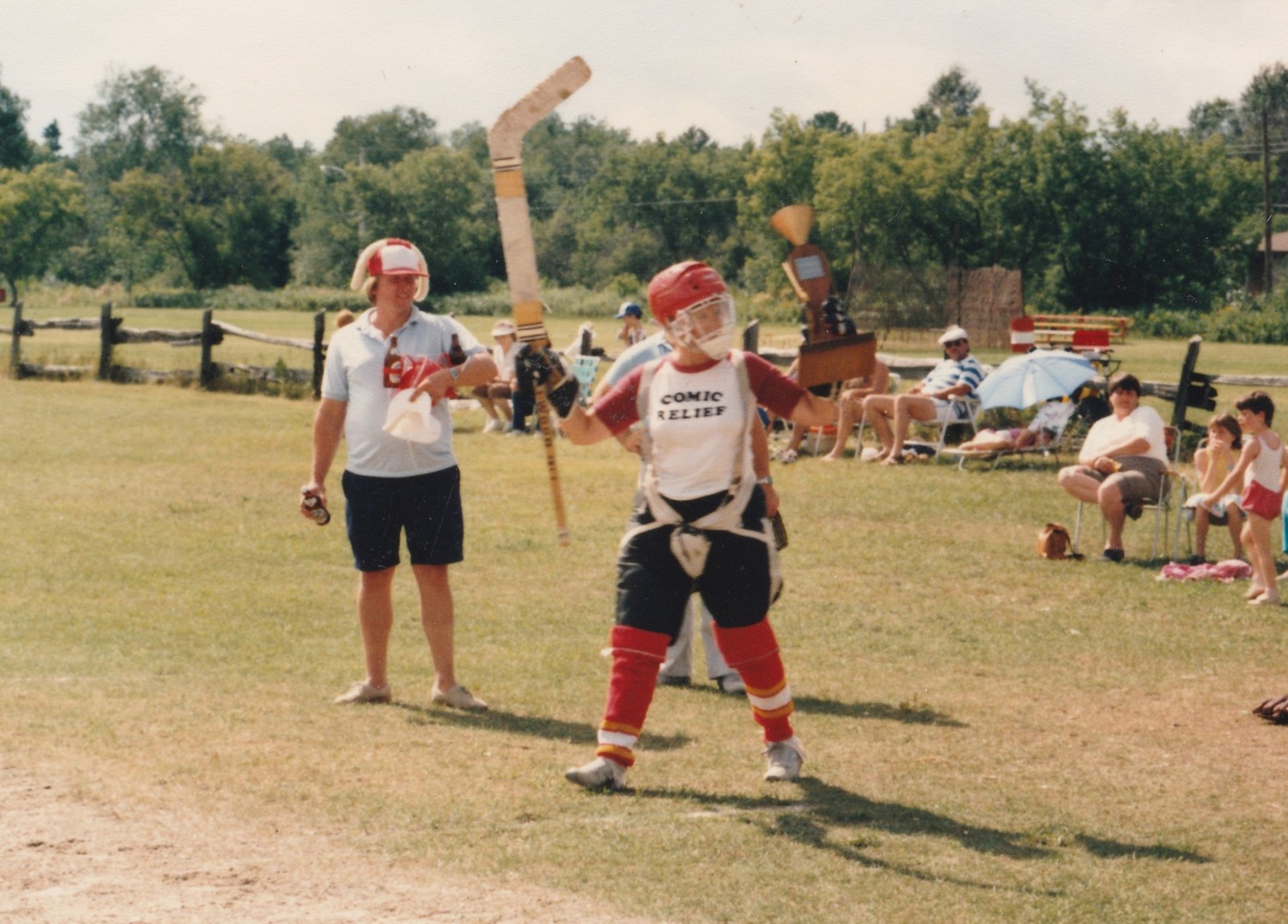
Operating such a successful tournament keeps the organizers busy year round. “Tournament planning begins in late August as soon as the tournament is over,” Erick observes. “Sending out invitations, contacting teams, scheduling, discs being painted for the teams that want a special request, applying for permits, ordering lime and ball equipment for the fields. Prizes and beer tent supplies need to be purchased. The list is endless, but once again is accompanied with the volunteer hours. Over the years we have spent endless hours laughing while designing and painting discs for the outfield fences. For many years we have spent endless hours creating floats for the local Santa Claus parades, by winning first prize! Some people will remember Bert and Ernie and Big Bird.”
“One year there was a fire during the tournament,” Beth recalls. “Most of the guys on the Burnt River team were on the volunteer fire department, so they just drove the truck onto the outfield, the guys jumped on and they drove away. The game had to be suspended. The team they were playing was from Toronto and was wondering what was happening. But they came back to finish the game. The firefighters use the trucks to water down the fields before the weekend. In the past they also used the trucks to water the field between the games.”
“The tournament survived COVID,” Ruth says. “Today there are 36 teams competing. I think that people enjoy coming because it is a weekend where men and women play together. It’s a very social weekend. We work hard to make sure that it is good for families. It’s a great excuse to spend time together. Visiting teams rent a cottage and have a fun weekend with their kids. Many teams like to play their two games on Saturday and then they can hang out at the cottage on Sunday.”
“Today, a lot of the teams are in their second or third generation,” Beth explains. “Their parents played and now their kids are keeping it going. Some teams include the grandchildren of the original players. There are many teams and people that have been coming for 30 years or more—including some locals. When I started organizing the tournament, Bill Handley arranged for the volunteers to care for the infield. Now his son Greg is volunteering to do that. Bill was one of the original volunteers, and he still helps the community by making ice at the rink in winter. Ronnie Campbell used to come and draw the lines and rake the outfield. Now his son, Randy, comes to help with that. It is still the same core group. There were not any falling outs over the years.”
The tournament serves as a fundraiser for the community. Ruth observes: “The tournament raised the money to pay for the majority of the park improvements as well as a number of building projects.” Beth adds: “We try to share with any worthwhile project. A child on one team had cancer, so we supported Cancer Bloom.” Each year the tournament organizers donate to support worthwhile causes. “Donations have been made biannually to all the local food banks. As food insecurity continued to grow in our community, the tournament organizers announced the creation of a legacy trust of $45,000 for local youth education.”
“We are proud that a small community has managed to build that park, playgrounds, ice rink and tennis court and have kept a lob ball tournament going for 50 years with very little outside support,” Ruth says. “Many people would assume that it is tax payers’ dollars that paid for it, but it is not. It is all volunteer based. No one was paid to give up their time, to cut the grass, rake and fertilize the field or paint. Every year we paint the bleachers and the discs that go on the field. The flags are all sewn and hung by people in town. The all-important beer tent is erected on Friday night. Then after the weekend they clean it all up and store it for the next year. Everything that you see there has been made or bought by volunteers. The City Council does not provide garbage pick up, help with the fences, outhouses, fertilizing or weed control for ball diamonds. None of the bases, lining equipment, bleachers or bench maintenance is done by the City. Cleaning the park and collecting garbage each day is done by volunteers and funded by the tournament. The only service provided by the City is grass cutting, which is usually done last minute.”
“The 50th anniversary should be a celebration of the volunteers.” They are a very close-knit group of volunteers, that as they have worked together, have built lifelong friendships. “We are extremely proud of the park this tournament has built. Our team of volunteers are all heroes. Nothing would be possible without them.”
The 50th Anniversary Burnt River Lob Ball Tournament was August 1-3, 2026 at the Burnt River Somerville Centre.
This story is a memory and nobody’s memory is perfect. Sometimes details get a little mixed up, things get forgotten or overlooked, and the perspective is inevitably subjective. If you notice something that not right, have something you would like to tell us, or a memory to share the museum would be happy to hear from you: [email protected]
This story is part of our partnership with Maryboro Lodge, The Fenelon Falls Museum and was written by Glenn Walker..
If you want to make a donation to the museum, you can e-transfer to: [email protected] or mail a cheque to :
Maryboro Lodge Museum
Box 179
50 Oak Street
Fenelon Falls, ON
K0M 1N0