KAWARTHA LAKES-FIRE!
How dreadful to hear! Today, we take for granted that the fire department will come and extinguish any blaze. Perhaps a building will burn down and it will be a tragedy for its occupants, but we tend not to worry that the blaze will jump from one building to another, levelling an urban block or town. Up to the mid twentieth century, many buildings had cedar shingle roofs and when sparks from a structure fire fell on a roof, it might ignite, especially in dry conditions.
When that dreaded call of ‘FIRE’ echoed through a community in the Victorian era, practically everybody came to do what they could to control the blaze. Communities formed bucket brigades, conveying water from whatever source was close at hand. People frantically climbed on roofs to wet the shingles, hoping to prevent a fire from spreading, or desperately trying to extinguish a fire that had broken out. Some buildings had ladders on their roof in case such a situation should arise. Even with everyone trying their best, not all fires could be contained to the building where they started and many communities had a great fire. Kinmount had the misfortune of suffering from multiple conflagrations, the most recent being the Great Fire of 1942.
By the late nineteenth century, many villages were seriously considering what they could do to reduce the risk of fire—for rural communities mechanized fire protection was not really practical until the mid twentieth century, but at least buildings were not as tightly grouped in the countryside. Omemee became a village separate from Emily Township in 1874, and its council soon began considering what could be done to provide better fire protection for the village. On August 7, 1877, spurred by a fire that consumed Cottingham’s saw and shingle mills, as well as John Kinkaid’s shingle mill, Omemee council decided to buy a hand-operated fire engine for $42.
Omemee was home to James Evans and Walter Redpath’s foundry, located on the southwest corner of King and Mill Streets, on the west bank of the Pigeon River (now Royal Canadian Legion Branch 497). One of this company’s many products was hand pump fire engines, and it would outfit several Ontario municipalities, including Bobcaygeon. Omemee’s original Evans & Redpath fire engine was on a cart, so a team of horses could pull it to a blaze. With a large seesaw handle, two men would stand on each side to depress the handle, while another volunteer would handle the hose. Today, this old hand fire engine is owned by the Oakwood Fire Department.
After the 1877 purchase, Omemee had a fire engine, but no fire brigade, so the following year, council committed that they would provide “any reasonable assistance to any person or persons desirous of getting up a Company.” On September 15, 1879, George Williams asked council for the equipment to form a hook and ladder company—ladders, axes, hooks, poles, rope, buckets, chains and a wagon, with a total cost of $183.15. The ladders were to provide access to fight fires—for instance, to be able to access roofs. The hooks were fitted on the end of the pike poles, which could be used to pull down walls to disassemble burning structures. Having a hook and ladder company and hand fire pump improved the community’s ability to fight fires, but everyone still needed to help if a blaze broke out.
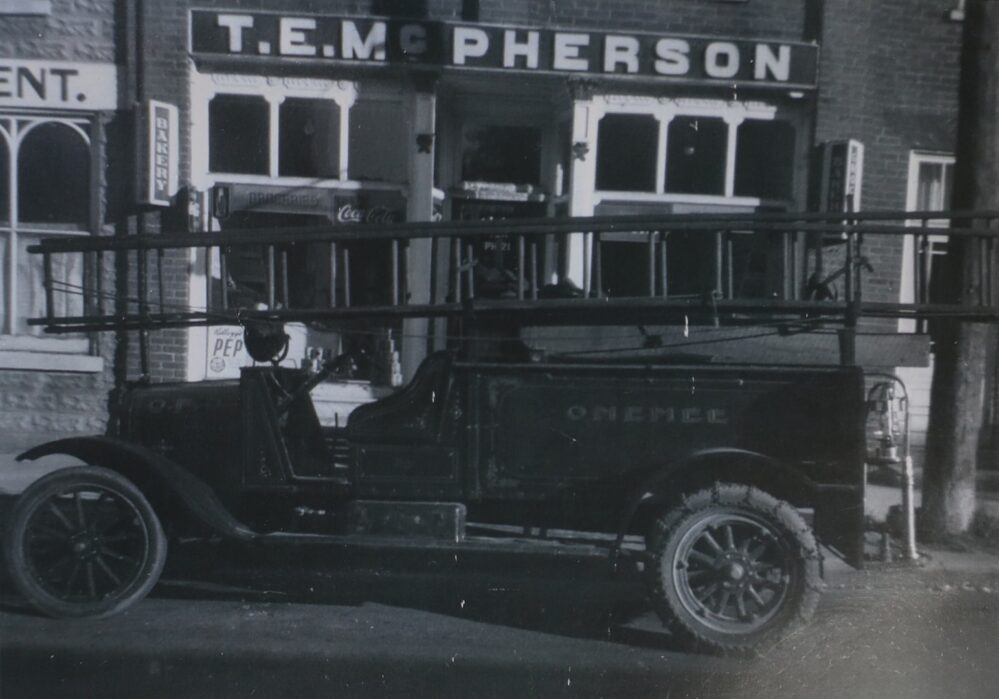
By the 1920s, automobiles were starting to become common in the Kawarthas, and could be modified to carry pumps. In 1926, Omemee Council purchased a Lorne Model 2 Chemical Pumper, with serial number 560 at a cost of nearly $1400—it was part of an equipment purchase totalling $3000.60 that Omemee Council approved on June 7, 1926.
The Lorne Tractorworks of Tilsonburg started with the frame, drivetrain and front clip (the part of a vehicle from the front door openings forward) of a 1925 Ford Model T (in that era, a 1925 vehicle was actually the vehicle from 1925—it was not yet customary to market a vehicle with a model year in advance of the present), and modified the original design to incorporate a 20-gallon tank, ladder rack, a 50-foot reel of 1 inch hose, an electric spotlight, two leather bucket holders, and hand crank siren, which was operated from the passenger seat. It had an American LaFrance hydrant connection with one pressure gauge. “On the back they had two coal oil lanterns, which was common for fire departments at that time.”
The fire truck could be started with a hand crank located on the front of the vehicle, or an electric starter, which was optional on Model Ts at that time. Canadian Model Ts were made at Walkerville (Windsor). As was customary, it was painted fire engine red, and the community could take pride in its newest acquisition. In the 1920s, it was unusual for a community of Omemee’s size to own a fire truck.
Modern firetrucks are designed to include pumps that take power from the vehicle’s engine, giving it the ability to pump water from its tank or a reservoir to fight a fire. The Lorne Model 2, did not take power from the engine, instead it carried soda ash and sulfuric acid, which could be dumped into the tank. The reservoir was designed to rotate, to mix the chemicals together, producing carbon dioxide, which would then pressurize the hose so it could spray much of its 20-gallon capacity through the line. At the time, chemical fire trucks were promoted as being more effective than spraying water and were commonly seen as a superior means of fire suppression, but in time it was realized that these claims were unfounded. They did have the advantage of providing a contained way to pressurize water.
“20 Gallons is not much water,” Doug observes. “That’s four five-gallon pails. If you are fighting a structure fire, 20 gallons of water is nothing. It would not take very long for the bucket brigade to move that much water, if there was a source of water anywhere near the blaze. It would not have been very effective, maybe it was just to say the town had something other than the bucket brigade. Today, pumper trucks are rated at 1200 or 1500 gallons per minute.”

If Omemee had a system of fire hydrants, the truck could have worked off the hydrants. Large cities might have this infrastructure, but in the 1920s, it would be highly unusual for a rural community like Omemee. Because the fire truck could not pump much water on its own, “the fire department had a gas motor and a water pump in a trailer that could be pulled behind it. They would park it beside a dug well or the river, put a suction hose down, and pump the water to the fire truck. The pump on the trailer would pressurize the water, so they could use the hose to fight the fire—but they would only have one hose to work with.”
For someone who is used to the conveniences of driving a modern vehicle, operating a 1925 Model-T is an interesting experience. There are two levers on the steering column. The left lever is a spark advance, which manually controlled the ignition timing. It took practice to learn how to set the spark advance for different speeds and loads. It would be pushed forward to start the vehicle, then pulled back to control performance, for instance, when climbing a steep hill. The other lever controlled the throttle. So instead of depressing a gas pedal, the driver would pull back the throttle lever to accelerate. “To start it you have to put the throttle and spark advance in the proper place. Originally, it did have a battery. If you turn the key the opposite way, you can start it using the magneto, with the hand crank.”
The 1925 Fire Truck has three pedals. Depressing the left pedal, keeps the vehicle in first gear; the middle pedal is reverse and the right pedal is a brake. There is also a lever extending up from the floor. It functions as a parking brake, neutral and second gear. To move forwards, the driver would depress the first gear pedal, bring the truck up to speed, then slowly let off the pedal while moving the floor-mounted lever forward. To slow down, the driver would pull the lever back to shift out of second gear to neutral (but not go too far and activate the parking brake), then carefully depress the first gear pedal.
With an 18-horsepower engine (modern pumper trucks are often 300-450 horsepower), the Model T firetruck has a “top speed of something like 25 or 30 miles per hour. But you probably don’t want to drive much faster than 20 miles per hour, because it has no power steering. It is pretty easy to turn the wheel, because the tires are much narrower than they are on a modern vehicle, and there is not a lot of weight to the vehicle.”
Though it does not have power steering, the 1925 Model T Fire Truck turns quite readily, but it is more difficult to make a small, smooth adjustment of direction than on a modern vehicle. While driving, the vehicle feels more top heavy than current equivalents. The driver can look much more directly down at the road over the short hood of the vehicle and it lacks a windshield, so you feel the speed you are travelling much more than in today’s cars. The fire truck seats two passengers, who are totally exposed to the elements, and there are no seat belts. “Maybe firefighters would have ridden on the tail board too.”
“As a Model T, there is no fuel pump, it is just a gravity feed from the tank to the carburetor. Instead of an oil pump, there is a slinger system. The water is not pumped, it moves by convection. The vehicle has a pulley from the engine going down to a generator which charges the battery.”
In the first half of the twentieth century, roads were not consistently plowed in winter, especially in rural areas. At the time this fire truck was purchased, farmers often assumed that automobiles were for summer use, if they were fortunate enough to have one, and horse and sleigh would be used in winter. Villages were more reliably cleared than the side roads, and the fire truck had large lugs on its rear tires to give it better traction in snow or mud. “Back then, they left chains on the tires year-round for better traction. It was stored in a shed on Mary Street, near where the Convenience Hut is today. There was no fire tower, because they did not have hoses to hang to dry.”
In 1950, Omemee purchased a 1949 GMC fire truck that incorporated a mechanical pumper, “it could pump 250 gallons per minute.” For couple of years the old fire truck was kept in reserve, but because the new truck was so much better, its days in active service were numbered. Put in a storage shed, it was no longer maintained though it just needed minor repairs. In the late 1950s, the Reeve of Omemee was chatting with Ken Vivian, owner of Vivian Motors in Shannonville. Ken was very interested in older Fords and was excited to acquire and retore the vehicle. “Folklore has it that it was traded for a bottle of whiskey—no one seems to know the exact date.”
Ken had a collection of Model Ts and Model As that he enjoyed working on. Supported by sponsorships from Belleville businesses, Ken and all 59 Belleville Professional Fire Fighters worked together, lovingly taking the old fire truck apart and rebuilt it, piece by piece. Carm Nobes repainted the fire truck glossy red and Jack Stewart detailed all the intricate designs on the truck—it would read “Shannonville,” then later “Belleville.” Because the old siren had disappeared, Belleville Parks and Recreation donated a handcrank siren from an ice rink. By late winter 1977, the job was complete. They would take the truck to Queen’s Park, and it was used for many weddings of fire fighters and their children. It was displayed at public events, including the Belleville Firefighters’ toy drive for underprivileged children.
When Ken passed away, circa 1993, the old fire truck was put up for auction. Omemee fire chief Buck Robertson “said we might have a chance of getting our original fire truck back. We sent two fellas down, who looked it over. We went to the bank and got preapproval for a $15,000 loan and were pretty confident that this would be enough money. Don James and Cornelius Jileson went to the auction, but the bidding went above $15,000. They both agreed to kick in an extra thousand to bring it home, but were outbid by Ken’s daughter, Helen Breadman. She came over afterwards and apologized. But she thought that because the Belleville Fire Department had put so much work into it with her father, that they should have the use of it. We assumed that we would never see it again.”
“Our 1949 firetruck had been taken out of service, so we started putting money into restoring it. Then in 2008, we were contacted by Ken Breadman. He said this his mother had always felt very badly that she had outbid us and asked if we wanted to buy the fire truck. But he told us there were collectors in the United States who were interested in buying it if we were not. The asking price was $20,000, but he agreed to sell it for $17,000.” The Omemee-Emily Emergency Response Association and the Omemee Chest Fund contributed a total of $20,000, which allowed a budget to cover the taxes, safety and some restoration work.
When the time came to pick the truck up, Doug remembered that it had been the former fire chief Buck Robertson who had started the conversation about bringing the truck back to Omemee. “Buck was living in Napanee with his son. It took some doing, but I convinced him to drive the truck onto the trailer to bring it home. It was a tribute to him that he loaded it on the trailer… That was 15 years after the work had begun to bring it home.”
Since Justin Mark and Doug floated the old Model T Fire truck back to Omemee on June 16, 2008, “it has been a huge part of my life.” John Lyon of Fenelon Falls repainted the lettering to once again read ‘Omemee.’ “Don Fitch of Pleasant Point, a self-taught Model T expert rebuilt the motor and the transmission.” Doug maintains the vehicle: “It’s not that much work to maintain, since it is not a daily driver. You have to change the oil and there are little cups that you have to squirt oil into with an oil can. There is a cup for the transmission that you have to fill up with grease. We had to put new tires on the front.” When the white chip truck at Fowlers Corners caught on fire and was written off by insurance, the firefighters acquired it and converted it to move the fire truck to events. “I once drove it to Lindsay on Highway 7 to attend an event, and I felt like was risking my life. I’m not going to do that again!”

Though they had not yet had the time to repaint the lettering, the 1925 fire truck appeared in the 2008 Omemee Santa Claus parade, “we used helmets to cover up the ‘Belleville’ lettering,” and has been featured at many events since. “When you drive it in a parade and older people see it coming, they start clapping and smiling—you can see the memories being brought back. Even kids are impressed with it. I remember one with his pants halfway down to his knees, giving me a thumbs up for a cool ride. One year, when we had it in front of the firehall for Omemee’s Pioneer Days, John Deyell stopped by and told us about when he had driven the truck. He is the only person I ever met who had driven it while it was in service.”
This story is a memory and nobody’s memory is perfect. Sometimes details get a little mixed up, things get forgotten or overlooked, and the perspective is inevitably subjective. If you notice something that not right, have something you would like to tell us, or a memory to share the museum would be happy to hear from you: [email protected]
This story is part of our partnership with Maryboro Lodge, The Fenelon Falls Museum and was written by Glenn Walker.
If you want to make a donation to the museum, you can e-transfer to: [email protected] or mail a cheque to :
Maryboro Lodge Museum
Box 179
50 Oak Street
Fenelon Falls, ON
K0M 1N0